
How easy it is to misattribute a quote
God has put eternity into man's heart. - Solomon

How easily we misattribute quotes
You’re in the zone, you’re writing a great piece and a relevant quote comes to mind. Now you’re not completely sure what the exact quote is… Come to think of it, you’re not even completely certain you know who said it… so you Google it.
Well, now you’re in over your head. Because Google, especially the newer AI-powered Google, is happy to treat every Facebook post as an authoritative source. Every motivational social post with a liberal paraphrase is in the mix.
I had the perfect quote in mind for my piece, the one that says something like: All mankind has a God-shaped hole in their heart… Who said that? Was it C.S. Lewis?
Google assured me that C.S. Lewis wrote: “There is a God-shaped vacuum in the heart of each man which cannot be satisfied by any created thing.”
Hmm… Really? Where did he write this? So I keep digging… Oh, actually C.S. Lewis never did write that, it was actually Blaise Pascal, the 17th century French mathematician, and what he actually wrote was: “There is a God-shaped vacuum in the heart of each man which cannot be satisfied by any created thing but only by God the Creator, made known through Jesus Christ.”
Cool, that’s even better. But wait, where did Pascal write this? I have Les Pensées, what chapter should I look in?
Well, he never actually wrote that either! But Google assures me that this is a faithful paraphrase…
OK… But a faithful paraphrase is not a quote. So why so many sources claiming it is a quote attributed to Pascal? Well if enough people are wrong about it, then guess what? Google turns it into fact.
If you are interested in more than just a watered-down paraphrase made for facebook posts… Then you have more work to do.
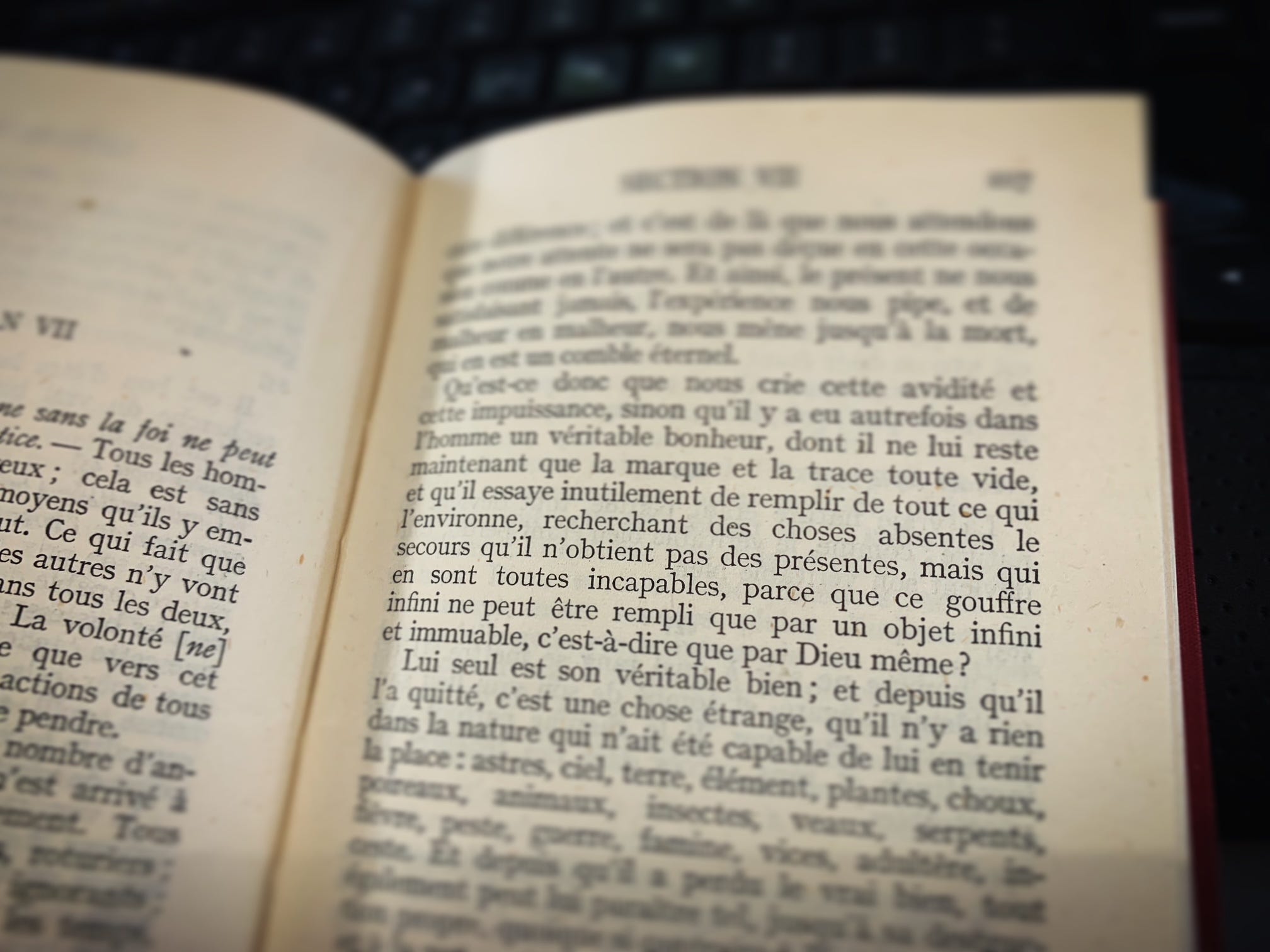
So I tracked down the original text in his book Les Pensées chapter VII, 425 Seconde partie. This is what he actually wrote:
« Que crierait donc cet appétit et cette impuissance, sinon qu’il y a eu autrefois dans l’homme un vrai bonheur, dont il ne lui reste plus maintenant que la marque et la trace toutes vides, et qu’il essaie inutilement de remplir de tout ce qui l’environne, en cherchant dans les choses absentes le secours qu’il n’obtient pas des présentes ? Mais elles en sont toutes incapables, parce que ce gouffre infini ne peut être rempli que par un objet infini et immuable, c’est-à-dire par Dieu même »
Not quite as pithy, but so much richer!
“What are we to understand by our deep-seeded yearning combined with our utter powerlessness to fulfill it? It tells us that true fulfillment was once found in man, but all that now remains is an empty imprint of it, and man tries in vain to fill that void with all that he sees around him and he seeks to acquire what he does not have in the same vain hope of relief from his yearning. But all these things are powerless, because this infinite abyss can only ever be filled by an infinite and immutable object, in other words by God himself.”
I guess 17th Century French philosopher mathematicians were not trained to write for impactful social media posts… What a breath of fresh air!